


Founded in 2008 TAILUN is one of the largest coating manufacturers in China, and is committed to the technical research and development and production of adhesive materials in consumer electronics, automotive, electrical and other industries Main products include protective film, adhesive tape, release film and PI products, etc.2008 Suzhou Tailun established / 2014 11x Coating lines; Taiwan Tailun established/2015 13x Coating lines / 2016 Tailun Viet Nam established / 2018 Ju cheng tai established / 2019 Delian established; Ning xia Heng chan established / 2021 Decided to invest in Runbang / 2022 18+2 Coating lines; Ju cheng tai and Run bang went into operation / 2023 Ning xia Hengchang went into operation
Production Market
600+ customers annually. Products are exported to Vietnam, Singapore, India, the United States, Germany and so on.
R&D Capability
7 invention patents, 3 high-tech product certification certificates, 8 utility model patents, national high-tech enterprise, Suzhou Engineering Research Center.
Production Equipment
18 production coating lines / 9 rewinding machines
2 sample coating lines / 18 slitting machines / 11 cutting machines
Our Factory
Founded in 2008 TAILUN is one of the largest coating manufacturers in China, and is committed to the technical research and development and production of adhesive materials in consumer electronics, automotive, electrical and other industries Main products include protective film, adhesive tape, release film and PI products, etc.

The mesh release film (paper) is formed through rapid cooling and embossing processing, with clear patterns, no crystal points, spots or impurities, beautiful appearance, uniform grid shape, and good temperature resistance.

Coated with fluorine release film on the surface of the substrate, the fluorine release film does not react with the silicone adhesive surface and the release force is stable; Widely used in the production and manufacturing of PI, green high-temperature tape, silicone double-sided tape die-cutting and punching, thermal conductive silicone tape casting and other industrial products in the adhesive system.

Coating non silicon release on the surface of the substrate performs better in the electronic material industry that is sensitive to silicon. We often use non silicon release bonded silicone products, and some customers who require no silicon at all require such release.

Coating silicone oil release agent on the surface of the substrate, silicone release agent has advantages such as high and low temperature resistance, good water resistance, and good fluidity, and is commonly used for bonding acrylic adhesive, polyurethane, etc.

R-PET release film: Tailun uses chemical recovery method to reverse recover waste, removes impurities after alcoholysis of PET waste, and produces R-PET after multiple purification, achieving efficient recovery and regeneration cycle under the premise of quality assurance.

Due to the various characteristics of PE polyethylene film, PE release film can be utilized in multiple fields. Due to its price advantage, PE is considered the best alternative to release paper.

PP polypropylene film has good heat resistance and stability. The characteristics of polypropylene ultimately vary depending on the type, which enables the use of PP release membranes in many fields.

The main characteristics of PET polyester film are its excellent heat resistance and stability.
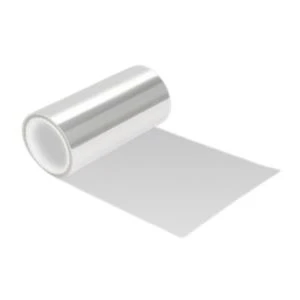
PET release film is a commonly used thermal transfer material. Its base material is PET. It is also called silicone oil-coated silicone oil film. Regular thickness is from 25um to 150um. It has hot and cold tear and glossy matte surfaces. After anti-static and anti-scratch treatment, the product has good adsorption and fit. 01 Residual adhesion rate The remaining standing rate refers to the force during the second peeling after the initial peeling, and the data obtained after calculation, which mainly reflects the effect of silicone oil curing. The residual adhesion rate of UV-cured silicone oil is generally 100%, and the residual adhesion rate of thermal-cured silicone oil is relatively high at 90%.
Advantages of PET Release Film
Improve production efficiency
PET release film can effectively reduce problems such as tool friction, adhesion and damage during the manufacturing process, thereby improving production efficiency and reducing production costs.
Reduce structural complexity
PET release film can be cut and designed according to different tool shapes and production requirements, thereby reducing product structural complexity and production difficulty.
Reduce process links
PET release film can replace traditional anti-adhesives, coatings, glues and other materials, thereby reducing the complexity of the manufacturing process and reducing process links and time costs in the production process.
Improve surface quality
PET release film can make the product surface smooth and flawless, thereby improving the beauty and quality of the product.
Transfer Printing
PET Release Film has good heat resistance, strength and rigidity, and is widely used as a carrier for transfer printing. The applicable industries can be divided into two categories.
PET release liner-> printed pattern -> adhesive coating->heat and pressure transfer to porcelain, glass, metal, plastic, cotton fabric, leather and other materials. It has the advantages of good compatibility, low cost, accurate color registration, and green environmental protection.
In-Mold Decoration by Roller (IMR)
Release liner->printing ink->adhesive coating->inner plastic injection->Ink and plastic bonding->The release film will be automatically separated from the ink after the mold is opened. IMR products have a metal texture with light weight, good light transmittance, bright colors and high brightness. It is used in large-volume, high-value-added products, such as mobile phones, digital cameras, MP3, mouse, DVD panels and cosmetic boxes.
Packaging Materials
PET release film is the carrier film, coat the color layer on the release layer and vacuum aluminize -> coat the aluminized surface with adhesive and composite with other substrates (paper) and dry -> tear off the release film. It can produce cardboard with metallic texture. Its advantages are non-toxic and odorless, and it is suitable for the packaging of high-end cigarettes, food, medicine, alcohol, gifts, daily necessities, cosmetics, etc.
Reflective PET
Reflective pet has excellent optical properties, surface flatness, thermal stability and aging resistance. Production process: aluminized PET film -> coating pressure sensitive adhesive -> adhering glass beads with release film -> coating protective layer. reflective pet is used in road traffic signs, vehicle number plates, road cones, textiles, functional fabrics, clothes, shoe materials, etc.
Adhesive Tape/Surface Protection Film
Adhesive tape and surface protection film is composed of release liner, adhesive, substrate, suitable for single-sided tape, double-sided tape, label, protective film such as mobile phone, notebook computer display protective film, electronic die-cutting process protective film.
Baking: Release paper can be used in baking, especially when making pastries and bread. It prevents baked goods from sticking to the baking sheet, making the baking process more convenient and hygienic.
Barbecue: The release paper can be used for barbecue, especially when grilling chicken wings and kebabs. It prevents meat from sticking to the grill, making it easier to flip and cook.
Packaging: Release paper can be used to package food, especially greasy food. It prevents food from sticking to the wrapping paper, making the packaging more beautiful and hygienic.
Make handicrafts: Release paper can be used to make handicrafts, especially when making candles and soaps. It prevents material from sticking to the tool, making fabrication easier and cleaner.
Printing: Release paper can be used for printing, especially when printing labels and stickers. It prevents printed materials from sticking to the press, making printing easier and more efficient.
Medical: Release paper can be used in the medical field, especially when making medical dressings and surgical instruments. It prevents materials from sticking to surgical instruments, making surgery safer and more hygienic.
Industry: Release paper is widely used in industrial fields, especially in glue-coated products. It can play a good anti-sticking role and is easier and more efficient during use.
PET Release Film Requirements
| Item | Unit | Requirement | Test Method | |
| Tensile Strength | MPa | ≧150 | ASTM D882 | |
| Elongation at Break | % | ≧70 | ||
| Elastic Modulus | MPa | ≧3500 | ||
| Thermal Shrinkage | MD | % | ≦1.0 | ASTM D1204 |
| TD | % | ≦0.5 | ||
| Transmittance | % | ≧85 | ASTM D1003 | |
| Haze | % | 1.5~10 | ||
| Friction Coefficient | Dynamic | ≦0.45 | ASTM D1894 | |
| Static | ≦0.4 | |||
| Surface Energy | dyn | ≧52 | ASTM D2578 | |
| Surface Resistance | Ω | 108~1011 | ASTM D257 | |
Factors Affecting the Appearance Quality of PET Release Film
Coating head
The coating head is widely used in the production of PET release film. There are many methods, nothing more than slightly improving its appearance performance. It can be improved, but remember, no more than 20% increase. Otherwise a rainbow pattern will be produced.
Coating agent formula
Most of the known formulas in the coating field use 120# solvent naphtha, but from the perspective of coating PET release film, there are better solvents, but many companies, as the core research and development part, generally cannot share or use Special solvents harmful to the human body.

Drying tunnel
Professional PET release film is inseparable from the drying channel, and the design of the drying channel also determines the quality of production. Although general manufacturers will buy other people's coating production lines, they also need to cooperate in the follow-up work in order to make a good PET release film.
Temperature
The core point to solve the appearance problem of PET release film is how to set a reasonable temperature curve, from what temperature enters the drying path, to what temperature is most conducive to solvent volatilization, etc.
How to Choose PET Release Film
Pay attention to the cost performance of the release film Although each brand of PET release film will have some differences in price, it is generally in a reasonable range. Therefore, if you want to get a high-quality and cheap PET release film, you must pay attention to multiple brands of PET release film. Products are compared, and cost-effective release films are selected when the materials, processes, and quality are the same.
Pay attention to the characteristics of the release film Although the same type of substrate is used in the production of PET release film, different release agents will result in different release film characteristics, and the fields and ranges of use have their own focus. Therefore, when purchasing, it is not only necessary to look at the material of the PET release film, but also to choose according to the mechanical properties, chemical properties, and peeling properties.
Pay attention to the use range of release film The main purpose of purchasing PET release film is to meet the production needs of the product, so it must be selected according to the scope of use of the release film to ensure that it can meet the production requirements of the company's products. For example, PET release film used for sealing tape, waterproof membrane, etc. is suitable for single-sided release film; For reflective material back adhesive protection, it is suitable for double-sided release film.
PET Release Film Production Process
Raw material preparation: Use high-quality PET raw material particles to ensure excellent basic performance of the membrane material.
Melting and extrusion: PET particles are melted at high temperatures and extruded through an extruder to form a film.
Stretching and orientation: The prepared primary film is oriented through the heating and stretching process to enhance its physical properties.
Release coating treatment: Apply a layer of release agent evenly on the surface of the PET film. Common release agents include silicone oil, etc. The thickness and uniformity of the release coating directly affect the release effect, so it needs to be accurately controlled.
Curing and heat treatment: The coated membrane needs to be cured through heat treatment processes such as baking to ensure its good release and stability.
Cooling and coiling: After heat treatment, the film needs to be cooled for coiling. The cooling rate should not be too fast to prevent uneven shrinkage of the film.
Cutting and packaging: According to customer needs, large rolls of film materials are cut into specified specifications, and quality inspection, packaging and shipment are carried out.
The Importance of PET Release Film in Medical Devices
Shield On The Surface Of Medical Devices
In medical device manufacturing, keeping device surfaces clean and smooth is critical. As a surface protection material, PET release film can effectively prevent dust, dirt, scratches, etc. from damaging the surface of medical devices. This shielding function not only maintains the appearance of the device but also ensures the hygiene and quality of the device, complying with the strict health and safety requirements of the medical device industry.
A Smooth Assistant In The Production Process
In the manufacturing process of medical devices, PET release film plays the role of a smooth assistant. Its smooth, non-adhesive surface allows medical devices to be formed and processed more smoothly during the manufacturing process. This helps improve production efficiency, reduce problems and losses in production, and ensure the quality and consistency of medical devices.
Chemical-resistant Protective Layer
Because PET release film has good chemical stability, it can be used as a protective layer for medical devices to prevent the devices from being corroded by chemical substances. In the medical field, devices often need to come into contact with various drugs and chemicals, and the chemical corrosion resistance of PET release film ensures the stability and safety of the device during use.
Innovative Design And Sustainable Development
The flexibility of PET release films allows it to adapt to medical devices of different shapes and sizes. This provides more possibilities for innovative design of medical devices, while also helping to reduce the waste of waste materials and resources, in line with the growing sustainable development needs of the medical device industry.
Things to Note When Using PET Release Film
Different industries and application fields require the use of different types of PET release film. When selecting a PET release film, consider the required temperature range, adhesion requirements, chemical resistance and other factors. Make sure you choose a release liner that meets your specific application needs.
PET release film usually has a special anti-stick coating on one side and ordinary paper on the other side. When using PET release film, make sure the anti-adhesive coating side is facing up to ensure its normal anti-adhesion function. If placed backwards, it may cause adhesion problems.
PET release film usually has a certain cost, and excessive use will increase production costs. When using PET release film, it should be used reasonably according to actual needs to avoid waste.
The PET release film should be stored in a dry and clean environment, away from harmful substances such as high temperature, moisture and chemicals. Avoid exposure to sunlight to prevent damage to the anti-stick coating.
During long-term use of PET release film, the status of the PET release film should be checked regularly. If the PET release film is found to be damaged, deformed or has coating peeling off, it should be replaced in time to ensure its normal anti-adhesion performance.
When using PET release film, you should comply with relevant safety operating procedures to ensure the safety of yourself and others. Especially when using PET release film in special environments such as high temperatures and chemicals, pay attention to protective measures to avoid accidents.


