

Hey there! As a supplier of FPC protective films, I've been getting a ton of questions lately about how our products affect the signal transmission of high-speed FPCs. So, I thought I'd take a deep dive into this topic and share some insights with you all.
First off, let's quickly go over what FPC and its protective film are. FPC, or Flexible Printed Circuit, is a crucial component in many electronic devices. It's flexible, lightweight, and can be bent, folded, or twisted to fit into tight spaces, making it perfect for modern electronics like smartphones, tablets, and wearables. And the FPC protective film, well, it's exactly what it sounds like – a film that protects the FPC from scratches, dust, moisture, and other environmental factors.
Now, onto the big question: how does the FPC protective film affect the signal transmission of high-speed FPCs?
Dielectric Properties
One of the key factors that influence signal transmission is the dielectric properties of the protective film. The dielectric constant, also known as the relative permittivity, determines how much the film can store electrical energy in an electric field. A lower dielectric constant means less signal loss due to energy storage in the film. When we're dealing with high-speed FPCs, even a small increase in signal loss can lead to significant degradation in performance.
Most of the high-quality FPC protective films we supply, like our Single-Layer Silicone Protection Film, are designed with a low dielectric constant. This helps to minimize the signal attenuation and maintain the integrity of the high-speed signals traveling through the FPC.
Thickness and Uniformity
The thickness and uniformity of the protective film also play a vital role in signal transmission. If the film is too thick, it can introduce additional capacitance and inductance, which can cause signal distortion and delay. On the other hand, if the film is not uniform in thickness, it can lead to uneven electrical properties across the FPC, resulting in inconsistent signal transmission.
Our manufacturing process ensures that the thickness of our protective films, such as the Two-Layer Silicone Protective Film, is precisely controlled and highly uniform. This way, we can ensure that the film doesn't negatively impact the high-speed signal transmission of the FPC.
Adhesion
The adhesion between the protective film and the FPC is another important aspect. If the film doesn't adhere well to the FPC, it can create air gaps or pockets, which can act as insulators and disrupt the signal flow. Moreover, poor adhesion can cause the film to peel off over time, exposing the FPC to potential damage and further affecting the signal transmission.
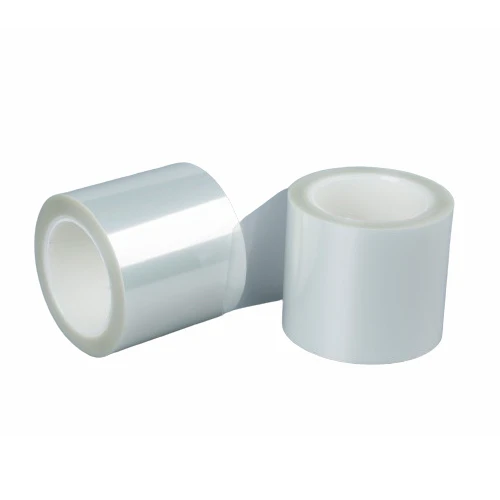

We've developed special adhesive formulas for our protective films, like the Die-cutting Protective Film, to ensure strong and reliable adhesion. The adhesive is carefully selected and tested to provide the right balance of stickiness and removability, so it can securely hold the film in place without leaving any residue when removed.
Electromagnetic Interference (EMI)
In high-speed FPCs, electromagnetic interference can be a major problem. The protective film can either help or hinder in reducing EMI. Some of our advanced protective films are designed with EMI shielding properties. They can act as a barrier to block out external electromagnetic fields and prevent them from interfering with the signals on the FPC.
By using our EMI - shielding protective films, you can enhance the signal quality and reliability of your high-speed FPCs, especially in environments with high levels of electromagnetic noise.
Thermal Properties
Heat can also have a significant impact on signal transmission in high-speed FPCs. Excessive heat can cause the FPC materials to expand and contract, which can lead to mechanical stress and electrical performance degradation. The protective film can help in dissipating heat from the FPC.
Our protective films are made from materials with good thermal conductivity. This allows them to transfer heat away from the FPC, keeping it at a stable temperature and ensuring consistent signal transmission.
Compatibility with FPC Materials
It's crucial that the protective film is compatible with the materials used in the FPC. Incompatible materials can react chemically, leading to the formation of new compounds that can affect the electrical properties of the FPC and its protective film.
We conduct extensive compatibility tests on our protective films to ensure that they work well with a wide range of FPC materials. This way, you can be confident that our films won't cause any unexpected issues with your high-speed FPCs.
Conclusion
In conclusion, the FPC protective film can have a significant impact on the signal transmission of high-speed FPCs. By choosing the right protective film with low dielectric constant, proper thickness and uniformity, good adhesion, EMI - shielding properties, thermal conductivity, and compatibility with FPC materials, you can enhance the performance and reliability of your high-speed FPCs.
If you're in the market for high - quality FPC protective films that won't compromise the signal transmission of your high - speed FPCs, we'd love to hear from you. Whether you're a small electronics startup or a large - scale manufacturer, we have the right solutions for you. Don't hesitate to reach out for a consultation or to discuss your specific requirements. Let's work together to ensure the best performance of your high - speed FPCs!
References
- Smith, J. (2020). "Advanced Materials for Flexible Printed Circuits." Journal of Electronic Materials.
- Chen, L. (2019). "Signal Transmission in High - Speed FPCs: Challenges and Solutions." IEEE Transactions on Circuits and Systems.
- Wang, H. (2021). "The Role of Protective Films in FPC Performance." International Journal of Electrical Engineering.